Conditions Prostate
Enlarged prostate
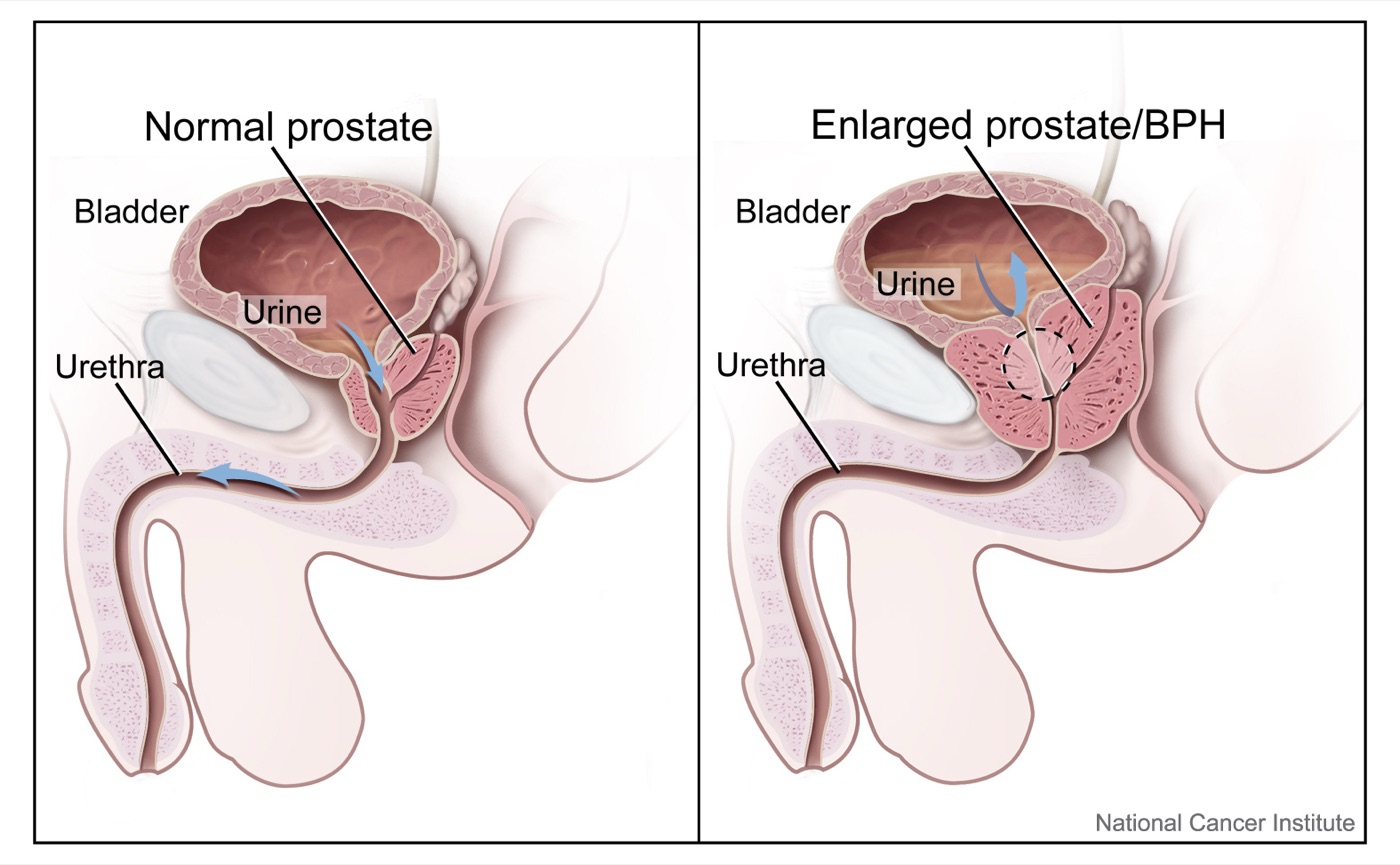
An enlarged prostate (benign prostatic hyperplasia, or BPH) is a prostate that has grown larger but is not cancer. It is very common as men get older, and the larger gland can press on the tube that carries urine.
- Is it cancer?
- No. Benign means it is not cancer.
- Main sign
- A weak or slow urine stream
- Do you have to treat it?
- Only if it bothers you or problems appear
What it is
The prostate wraps around the top of the urethra, the tube urine flows through. As the prostate grows, it can squeeze this tube and slow the stream. When it is severe, it can lead to urine infections, bladder stones, blood in the urine or being unable to urinate.

Common causes
- The prostate growing larger as men get older
- Drinking a lot in the evening
- Caffeine and alcohol
- Constipation
- Some cold and allergy medicines (decongestants and antihistamines)
The growth itself comes with age. The other items can make the symptoms worse.
What you may notice
- A weak or slow stream, trouble starting, or a stream that stops and starts
- A feeling that the bladder is not empty, and dribbling at the end
- Going often or in a hurry, and waking at night to urinate
How it is diagnosed
-
Symptom score
A short questionnaire (IPSS) shows how much your symptoms bother you. We also review your drinks and medicines.
-
Prostate exam and urine test
A urine test checks for infection or blood. A PSA blood test is done when it would change your care.
-
Flow test and bladder scan
Often a test of how fast you urinate and a check of how well your bladder empties. The prostate may also be measured with a scan or a scope.
Treatment choices
Treatment steps up from habit changes to medicines to a procedure, guided by how much your symptoms bother you.
-
Habit changes and watching
Less to drink in the evening, less caffeine and alcohol, and treating constipation.
- Best for
- Mild symptoms that do not bother you much
- Recovery
- No procedure
-
Medicines
Daily pills relax the prostate to ease flow, or slowly shrink a large prostate.
- Best for
- Bothersome symptoms, as the usual first medical step
- Recovery
- Relaxing pills work in days to weeks; shrinking pills over 3 to 6 months
-
Office steam treatment (Rezūm)
Small puffs of steam shrink the extra tissue over the next few months.
- Best for
- Small to medium prostates, if you want to avoid an operating room
- Recovery
- Catheter for a few days; full effect by about 3 months
-
Scope operations
TURP, HoLEP or GreenLight laser removes or vaporizes the blocking tissue through the urethra.
- Best for
- A strong, lasting stream; HoLEP suits a prostate of any size
- Recovery
- Catheter usually out within 1 to 3 days
-
Waterjet surgery (Aquablation)
A waterjet guided by ultrasound removes the blocking tissue, with no cut on the skin.
- Best for
- Small to large prostates, with a better chance of keeping ejaculation
- Recovery
- Catheter often out within 1 to 2 days
-
Robotic simple prostatectomy
Through small cuts in the belly, the bulky inner prostate is removed and the outer shell stays.
- Best for
- Very large prostates, or bladder stones or pouches to fix at the same time
- Recovery
- Hospital stay of one to several days
What shapes the choice
- How much your symptoms bother you
- The size and shape of your prostate
- Keeping ejaculation
- Blood thinners
- Your health
- What matters to you
We can go over each option in more detail at your visit.
Make an appointment
Call (215) 456-4600 to schedule, or request a visit online.
Request an appointment online